
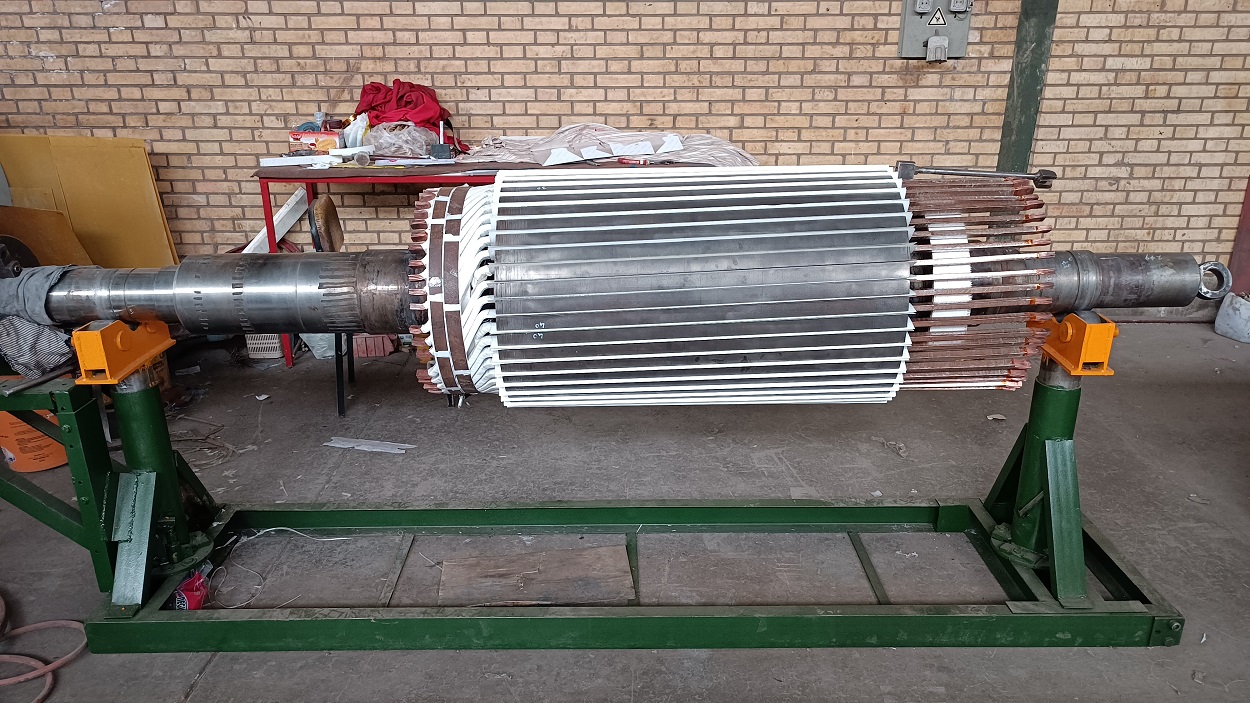

The rotor is the rotating component within the structure of an AC motor, positioned inside the stationary part known as the stator. Derived from the word “rotation,” the rotor is one of the essential parts of alternating current (AC) motors. In fact, it is impossible to find an AC motor that does not include a rotor.
The rotor is mounted on the stator shaft and rotates inside a hollow cylindrical structure with uneven electromagnetic poles. This rotation generates a magnetic field that enables the motor’s operation.
If you would like to learn more about the stator and how it works, you can read the article “What Is a Stator?” on our website.
Rotor function
In alternating current (AC) motors, the rotor’s function is to produce a magnetic field and thereby drive equipment such as washing machines, elevators, and similar devices.
Rotor components (rotor structure)
The rotor is designed to mount on the stator shaft in a way that enables rotation. The key components that make up the rotor are as follows:
- Rotor claws
- Rotor windings
- Positive and negative collectors
- Fan
Rotor operation
The positive and negative collectors on the rotor are connected to the positive and negative brushes on the stator, allowing electric current to be transferred to the collectors.
The two ends of the rotor windings are connected to these two collectors. When positive current flows from the positive brush to one end of the winding and negative current flows from the other collector to the opposite end, a potential difference is created across the winding, which generates a magnetic field inside it.
As soon as this magnetic field is formed in the winding, the claws around it alternately become N and S poles, effectively turning them into a magnet.
At this stage, when the magnetic field and motor rotation cause heat buildup in the winding and rotor, the fan mounted around the rotor prevents the temperature from rising excessively.
Types of rotors
Rotors come in various types that are selected based on their construction and application, and they are explained in detail in this Shahbaz Motor article. In general, AC motors are divided into two main categories: synchronous and induction. Each category uses its own specific rotor types, which will be examined individually in the following sections.
Salient-pole rotor
A salient-pole rotor is a rotor type used in synchronous machines, commonly found in generators and alternators. These rotors incorporate large magnetic poles whose pole faces are built from stacked steel laminations. In this design, the poles are mounted on and project outward from the rotor core.

Salient-pole rotors have a large diameter while their axial length is relatively short. They are mainly used in low-speed electrical machines, typically operating in the range of 100 to 1500 revolutions per minute. These rotors generally require a damper winding to suppress oscillations during operation. Salient-pole rotors are widely used in hydroelectric power plants.
Cylindrical (non-salient) rotor
The cylindrical, or non-salient, rotor is another type of rotor used in synchronous machines and is constructed from a solid steel shaft. In this rotor, direct current from an external source is supplied to slip rings equipped with brushes, creating the required electrical connections. Using a rectifier, the alternating current (AC) supply can also be converted to direct current (DC) and fed to the rotor without the need for brushes.
Because of its specific construction, the cylindrical rotor is mainly used in high-power, high-speed applications, in contrast to the salient-pole rotor. For example, it is commonly employed in electric motors that transmit speed to industrial gearboxes for speed reduction. A cylindrical rotor with 2 or 4 poles can operate at speeds of 3600 or 1800 revolutions per minute.
Squirrel-cage rotor
The squirrel-cage rotor belongs to the induction type. Its construction is designed similarly to a squirrel cage. Externally, it appears as a cylindrical rotor, inside which conductive bars are embedded; these bars extend through both ends of the cylinder and are short-circuited by end rings.
Wound-rotor (slip-ring) motor
The wound-rotor, or slip-ring rotor, is a type of induction rotor. As its name suggests, it is equipped with coil windings that are laid into the slots on the rotor body. The body of the wound rotor is cylindrical, and slip rings with brushes are mounted on its shaft.
By inserting external resistance into the rotor circuit, these rotors are capable of producing high starting torque. One of the main differences between a wound rotor and a squirrel-cage rotor lies in speed control: in wound-rotor designs, the motor’s speed and torque can be adjusted by varying the external resistance.
Thank you for taking the time to read this article.


